
No products in the cart.
Negative Ionizer Sections
There are many negative ion generators (ionizers) on the market, so it can be difficult to choose the best product. You may wonder what the differences are between various models. Here you find how to select the best negative ion generator that meets your requirements.
How far negative ions travel
Cool wind created by your air conditioner does not reach you!
You want to enjoy cool air as it is extremely hot, but the cool air created by your air conditioner does not reach you. It is just wasting electricity.
The same goes with negative ion generators. If negative ions do not reach you, the generator is wasting electricity. Some negative ion generators generate negative ions but only very few reach you.

Pay attention to the distance from the negative ion generator!
Negative ion counts are generally measured in (pcs/cc). You cannot evaluate performance of negative ion generators with this value only.
For example, a negative ion generator which generates 1,000,000 (pcs/cc) can be good or not so good. This is because the distance from the generator where this amount of negative ions can be detected is not shown.
Negative ion counts dramatically decrease as you go further away from the generator. There are products which emphasize the ion count detected at the blow off point while very few can be detected at 50cm away. This is why you need to pay attention to the distance.

The ion count at a distance away from the generator determines the performance of the generator.
Ion count in the blow off direction
The ion count detected at a certain distance away from the ion generator shows you how far negative ions travel.
You need to pay attention to the ion count at least in the blow off direction because most manufacturers do not provide ion count information in angled directions. It would be ideal if negative ion counts in the both directions were always available.

If the ion count at 1m away from the ion generator is below 10,000 (pcs/cc), the performance is not so good.
Ion count: Performance (for your reference)
- 300 (pcs/cc) at 50cm: Poor
- 3,000 (pcs/cc) at 50cm: Not so good
- 20,000 (pcs/cc) at 1m: Good
- 100,000 (pcs/cc) at 1m: Very good
| Related pages |
|
How widely negative ions spread out
Not always in the blow-off direction
As we mentioned in “Pay attention to the distance from the negative ion generator!”, negative ion counts dramatically decrease as you go further away. The same goes with angled directions.
It is possible that almost no negative ion molecule can be detected in the 30 degree direction. If you have such an ion generator, you always have to stay in the blow off direction in order to enjoy negative ions.
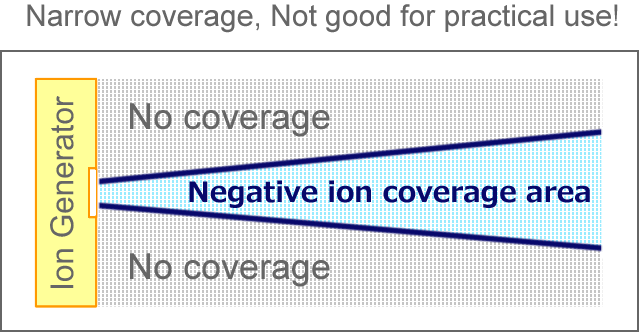
While cool air created by your air conditioner spreads throughout the room as time passes and temperature goes down, ion counts do not dramatically increase as time passes because negative ions vanish quickly. This is why negative ions need to spread in every direction.
Make sure negative ions spread in every direction
As mentioned above, a negative ion generator, which disperses negative ions to the blow off direction only, is not good for practical use. However, many models fail to perform this task because of technical difficulties. This is why you have to make sure that negative ions spread in every direction because you are not always in front of the generator.
How to make sure
Here is how to make sure that negative ions spread in every direction.Coverage area

The coverage area is often decided by the manufacturer itself with no industry standard, so it is just for your reference.Negative ion distribution
The negative ion distribution data shows how the ions spread. This data is not always available because very few companies disclose it. Here is the ion distribution data of the Medical Ion Mini.

| Related pages |
|
Performance is important
Appearance vs Performance
A negative ion generator which looks nice, powerful or is recommended by Professor xxxxx does not always perform well. The performance is more important.
Pay attention to the performance!
Appearance is important as your negative ion generator stays in your room but you have to pay more attention to the performance.
As we mentioned in “How far negative ions travel” and “How widely negative ions spread out”, the negative ion distribution data is very important.
If you can only find the negative ion count detected at the blow off point or at an unknown distance, you should contact the manufacturer for more information. Otherwise, you may end up with a quasi-ion generator.
Pay attention to specifications
Negative ion count (blow off direction)
| Specification item | Example | Importance |
|---|---|---|
| Negative ion count (blow off direction) | 20,000,000(pcs/cc at 0cm) 1,000,000(pcs/cc at 50cm) 700,000(pcs/cc at 100cm) | High |
Ion counts in blow off direction show you “How far negative ions travel”. You cannot evaluate performance of negative ion generators without negative ion count information.
It is possible that some million negative ion molecules are detected at the blow off point but very few can be detected at 50/100/200cm away.
If only less than 2,000-3,000 (pcs/cc at 1m) negative ions can be detected, the performance of the ion generator is not good and it is only good for mobile or other special use.
Not only ion counts in the blow off direction but also those in angled directions (found on the next page) are an important factor.
| Related pages |
|
Negative ion count (angled directions)
| Specification item | Example | Importance |
|---|---|---|
| Negative ion count (angled directions) | 500,000(pcs/cc in 30 degrees at 2m) 150,000(pcs/cc in 90 degrees at 2.5m) 10,000(pcs/cc in 180 degrees at 1m) | High |
Ion counts in angled directions show you “How widely negative ions spread out”. It is a very important factor to choose the best negative ion generator but very few manufacturers disclose it.
If very few negative ions can be detected in angled directions, the ion generator is just wasting electricity.
We suggest you should pay attention on how widely negative ions spread out.
| Related pages |
|
Maximum coverage area
| Specification item | Example | Importance |
|---|---|---|
| Maximum coverage area | 40 m2 (430 ft2) | High |
A maximum coverage area is just for your reference because it is decided by the manufacturer with no industry standard. We suggest you should choose the negative ion generator which covers the widest area possible.
It is ideal if negative ion count info in angled directions is available as it shows you how the ions can be distributed.
Life span
| Specification item | Example | Importance |
|---|---|---|
| Life span | 5 years+ | High |
We believe you want to purchase a product which can perform well for long periods.
Generally, ionizing needles determine the life span of negative ion generators which incorporate the discharging method.
Worn-out ionizing needles can cause lower ion counts or generation of highly concentrated ozone.
Before you purchase a negative ion generator you need to know the life span and how it is determined.
Safety measures
| Specification item | Example | Importance |
|---|---|---|
| Safety measures | Safety circuit, Ozone/EMI suppression | High |
Negative ion generators, which incorporate the discharging method, have internal circuits where high voltages are used. For your safety, we suggest you should choose a generator which is designed to prevent you from touching these circuits.
Some generators produce harmful ozone gas as the ionizing needles get worn out.
You should choose a safe product.
| Related pages |
|
Purification capability
| Specification item | Example | Importance |
|---|---|---|
| Purification capability | 98% of 0.1-0.3micron particles removed in 5 minutes | High |
Negative ions combine with dust and particles floating in the air and fall to the floor. As the result, the dust and particles no longer exist in the air. This is how the air is purified by negative ions.
Air purification capabilities are an important factor when choosing the best negative ion generator.
A negative ion generators, which can disperse plenty of negative ions throughout the room, has a high ability to remove dust and particles floating in the air.

Air purification capabilities are an important factor when choosing the right product but manufacturers do not always provide this information.
| Related pages |
|
Stable performance
| Specification item | Example | Importance |
|---|---|---|
| Stable performance | Designed to maintain performance under extreme conditions | Middle to High |
Temperature and humidity changes can significantly lower the performance negative ion generators which employ the discharging method.
You should choose a negative ions generator which is designed to maintain optimum performance under low/high temperature. Otherwise, it will not perform well under such conditions because the negative ion counts can dramatically drop.
This image shows you the Medical Ion Mini maintains optimum performance under temperature and humidity changes.

Very few products in the market are designed to maintain performance under extreme conditions.
Life span of ionizing needles
| Specification item | Example | Importance |
|---|---|---|
| Life span of ionizing needles | 5 years+ | Middle |

The life spans of negative ion generators which employ the discharging method are usually determined by the ionizing needles.
Ionizing needles gradually get worn out as a result of repetitive charging/discharging or by chemical reactions.
Worn out needles can lower negative ion counts or produce a lot of harmful ozone.
The life span of ionizing needles is an important factor because it determines the life span of the negative ion generator.
Positive ion count
| Specification item | Example | Importance |
|---|---|---|
| Positive ion counts | 0(pcs/cc) | Middle |
Negative ion generators can generate both positive/negative ions simultaneously, particularly if they employ the corona discharging method.
Positive ion generation lowers negative ion counts because they are cancelled out by their positive counterparts.
It is ideal not to produce positive ions.
| Related pages |
|
Ozone production
| Specification item | Example | Importance |
|---|---|---|
| Ozone production | 0.001ppm or less | Middle |
Most of negative ion generators which employ the discharging method generate negative ions and ozone simultaneously.
Ozone gas is used for sterilizing/deodorant purposes but it is harmful to the human body if it is highly concentrated. The safety limit set by the Ministry of Health, Labour and Welfare is less than 0.1ppm (in working areas).
Basically, a negative ion generator, which does not meet the safety standards, is not sold in the market. However, worn out ioznizing needles can generate highly concentrated ozone.
Ozone itself has no odor but it can give off an offensive stimulating smell when it reacts with other substances in the air. You have to choose a product which meets safety standards and make sure if it does not give off the odor caused by the reaction if you do not like the smell.
| Related pages |
|
Test operation
| Specification item | Example | Importance |
|---|---|---|
| Test operation | Comes with the ion detector for test operation | Middle |

You cannot tell if your negative ion generator is working properly because you cannot see ions with the naked eye.
A negative ion generator which has a built-in indicator light and/or comes with a detector is ideal because they assure you that it is generating negative ions.
| Related pages |
|
Maintenance
| Specification item | Example | Importance |
|---|---|---|
| Maintenance | Cleaning of the ionizing needles | Middle |
Maintenance procedures vary depending on the negative ion generator.
Some products require you to clean the ionizing needles or replace the filters on a regular basis, while those which generate negative ions by crashing water require you to clean/refill the water tanks.
You should know what maintenance work is required to maintain the performance before you purchase the negative ion generator.
Purchase of consumables
| Specification item | Example | Importance |
|---|---|---|
| Purchase of consumables | Not needed | Middle |
Some negative ion generators require you to purchase filters or other consumables on a regular basis.
You should know the expenditures before you purchase the generator because you have to continue to pay as long as you use it.
Wind noise generation
| Specification item | Example | Importance |
|---|---|---|
| Wind noise generation | No noise due to no fan | Middle |
Some negative ion generators have built-in fans/motors.
We suggest you should know the noise levels generated by the generator before you purchase it because you may be disturbed by the noise.
[Summary] The most important factor
Negative ions have to reach you!
There are several factors to consider when choosing the best negative ion generator. The most important factor is if negative ions reach you or not.
However, many manufacturers do not provide this most important information.
Negative ion count information in the blow off and angled directions shows you if the negative ions reach you.
For example, “Massive negative ions!” or “2,000,000 pcs negative ions!” does not ensure that the negative ions reach you.
Coverage areas are just for your reference only because there is no industry standard.
We suggest you should make sure that the negative ions will reach you before you purchase the product.